


01- What is Tajweed?
The word Tajweed means doing something well. It is to recite every letter correctly from its proper origin (makhraj) with its all qualities.
02- Why tajweed is important for recitation?
Learning “Tajweed” is very important for recitation because applying the rules of Tajweed protect us from making mistakes.
03- What are Mistakes in the recitation of Quran?
There are two types of mistakes.
1:- Clear Mistake (لحن الْجَلِى):
It is changing a letter or changing a sign (harakah). This type of mistake is haraam.
2:- Hidden Mistake (لحن الخَفِى):
It is ignoring ghunnah, ikhfa, iqlab, idgham etc. We should avoid this type of mistake.
04- What is Makhraj?
The place from where a letter comes out from our mouth is called makhraj. Read More
05- What are Throatal letters?
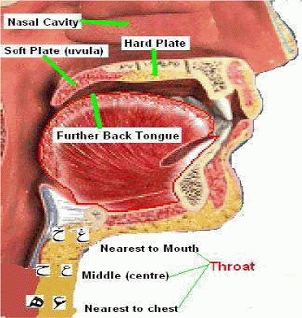
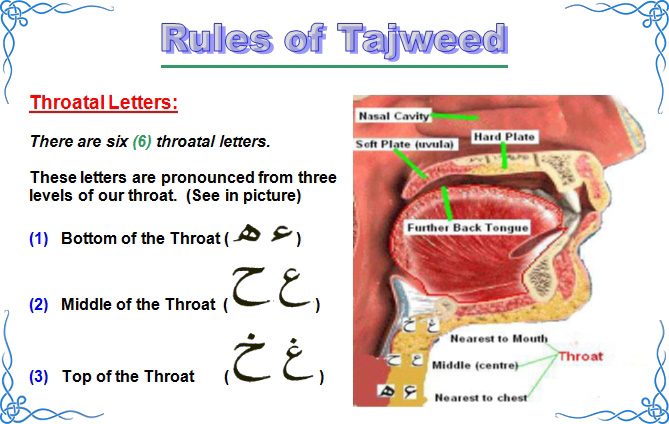
There are six (6) throatal letters.
These letters are pronounced from three levels of our throat.
1- Bottom of the Throat (ء ه )
2- Middle of the Throat ( ع ح )
3- Top of the Throat (غ خ)
06- What are bold letters?
There are seven (7) bold letters.
These letters are pronounced with a heavy and strong voice.
خ ص ض غ ط ق ظ
These are arranged in a combination
| ( خُصَّ ضَغْطٍ قِظْ ) |
07- What are movements or Harakaat?
There are three harakaat (Movements) in Arabic.
(1) (Fathah or Zabar) ( ــَـ ) (Prolong it for one count)
(2) (Kasrah or Zer) ( ــِـ ) (Prolong it for one count)
(3) (Dammah or Pesh) ( ــُـ ) (Prolong it for one count)
08- What is sukoon or jazm sign?
If a letter is without a harakat sign, it is called saakin (resting position), and a sign (ــْـ) appears over this letter is called Sukoon (jazm).
09- What are silent letters?
Silent letters are letters that are written in the Arabic script but are not pronounced when reciting the Quran. These letters don’t have any sign or sukoon (empty letters).
Here are some common examples of silent letters:
| رَضُوْا , مِنَ الْاُوْلٰى , مَاالْقَارِعَةُ اُولٰۤئِكَ , بِالْغَيْبِ ,صَلٰوةً |
10- What is tanween?
Tanween, also known as Nunation represents the sounds “an”, “in”, or “un” and are typically written as small symbols ( -ً -ٍ -ٌ )above or below the letter.
| كُفُوًا , شَطَطًا , كَذِبًا لُـمَزَةٍ , ھُـمَزَةٍ , سِنَةٌ |
11- What is ghunnah?
Ghunnah means a nasal sound produced when reciting the letters Noon or Meem with Tashdid ( ّ- ) sign. Ghunnah adds a distinct and melodious quality to the recitation when performed correctly.
( اِنَّ , ثُمَّ )
12- What are maddah letters?
Letters Alif ا , Wao وْ , and Yaa يْ are called maddah letters. When letter Alif ا comes after Fatha ﹷ , letter Wao sakin وْ comes after Dammah ﹹ , and letter Yaa sakin يْ comes after Kasrah ﹻ, we stretch (lengthen) the sound of the letter upto two measures of harakah.
( كَانَ , يَقُوْلُوْنَ , اَخِيْهِ )